
Infidelity means that one partner has a sexual or emotional relationship with another person, breaking an agreement of exclusivity that the couple made. Couples define that agreement differently. Some count secret online messaging as infidelity and some do not. For this reason, the first useful question in therapy is often what each partner understood the rules to be.
Why infidelity happens and who is affected
No single cause explains infidelity. In a review of the research, Fincham and May (2017) described a mix of factors that include dissatisfaction in the relationship, personality traits, attitudes toward sex and commitment, and simple opportunity. Allen and colleagues (2005) grouped the factors into three kinds: those within the person, those within the relationship, and those in the surrounding circumstances, such as work travel.
Atkins and colleagues (2001) analyzed a national random sample of married adults in the United States. They found that lower marital satisfaction and more permissive attitudes toward extramarital sex were linked to infidelity. These are correlations. They show patterns across many people, and they cannot tell us why one particular person was unfaithful.
In the consulting room, the explanation people give is often simpler and more confusing to them than any research model. A man in his forties may say that he loves his wife, never planned to leave her, and cannot understand what he was doing. Understanding the circumstances is useful, but it does not remove responsibility for the choice that was made.
The effect on the partner who finds out
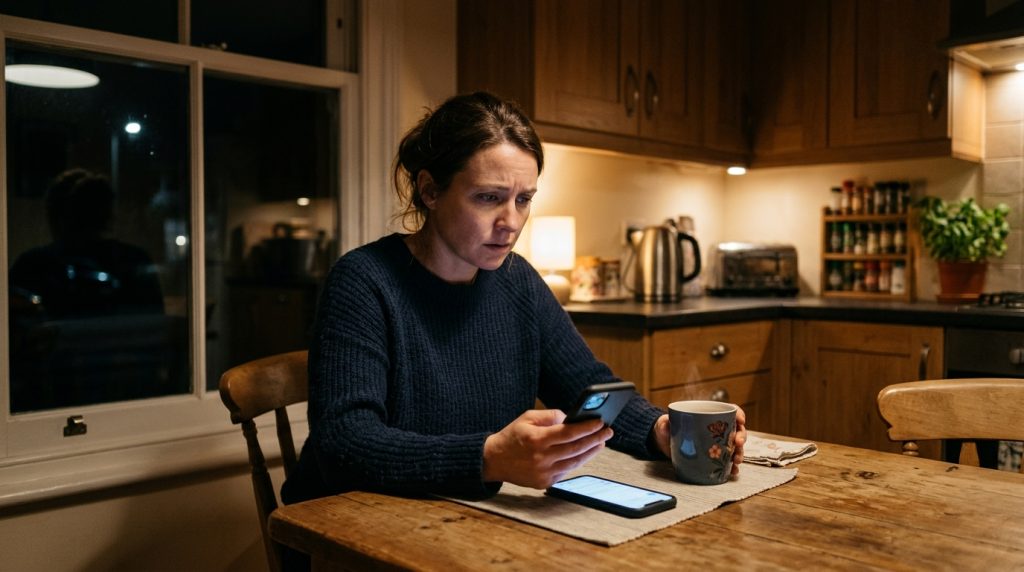
Discovering an affair can produce symptoms that resemble those seen after other severe shocks. The betrayed partner may have intrusive thoughts about the affair, poor sleep, loss of appetite, irritability, difficulty concentrating, and a strong urge to check phones and messages. Some people also develop depression or marked anxiety. Not everyone reaches the level of a psychiatric diagnosis, but the distress is real and can be intense.
The partner who was unfaithful is not free of suffering either. Guilt, shame, fear of losing the family and, in some cases, depression are common once the affair is known. Children may sense tension even when they are told nothing. These reactions do not cancel out each other, and each person needs attention to their own state.
In the first weeks after discovery, strong emotion makes clear thinking difficult, so major decisions about the relationship can usually wait.
This is a clinical observation more than a research finding, but it is consistent with what we know about decision-making under severe stress. A person who announces on the third day that the marriage is over, or that everything is forgiven, often feels differently a month later. Practical steps help in the meantime: keep regular meals and sleep hours, tell one or two trusted people, and avoid alcohol as a way of coping.
A medical or mental health visit is advisable if the low mood lasts most of the day for more than two weeks, if sleep is almost absent, or if the person feels that life is not worth living. Thoughts of self-harm after a betrayal should always be taken seriously and discussed with a doctor, a therapist or an emergency service.
Steps toward recovery, with or without the relationship
Some couples stay together after infidelity and some separate. Neither outcome is a measure of success or failure. Gordon, Baucom and Snyder (2004) described a treatment for couples in three stages. First, the couple deals with the emotional impact of the discovery. Second, they look for an understanding of how the affair happened. Third, they decide whether and how to move forward.
Their study included only a small number of couples and had no comparison group, so it shows that this approach is workable but does not prove that it is better than others. Larger controlled trials of therapy after infidelity are still needed. Even so, the order of the stages is sensible. Couples who attempt to discuss the reasons before the shock has settled usually end up in repeated arguments.
Several practical points hold in most cases. The affair must end completely, with no continuing contact. The unfaithful partner needs to answer reasonable questions honestly and patiently, although graphic details tend to feed intrusive images and rarely bring relief. Setting a fixed time for these conversations, for example thirty minutes in the evening, keeps them from taking over the whole day.
Trust returns slowly and mainly through consistent behavior over months, not through promises. This usually means being open about whereabouts and phone use for a period that both partners agree on, and not treating the request for transparency as an attack. A sexual health check is also reasonable when there has been unprotected sex outside the relationship.
Individual therapy can help each partner separately, particularly when the affair is linked to depression, substance use, or an earlier history of betrayal or neglect. People who decide to separate also benefit from support, because the grief, anger and doubt do not end with the decision. Recovery usually takes many months, and in many cases more than a year.
References
- Allen, E. S., Atkins, D. C., Baucom, D. H., Snyder, D. K., Gordon, K. C., & Glass, S. P. (2005). Intrapersonal, interpersonal, and contextual factors in engaging in and responding to extramarital involvement. Clinical Psychology: Science and Practice, 12(2), 101-130.
- Atkins, D. C., Baucom, D. H., & Jacobson, N. S. (2001). Understanding infidelity: Correlates in a national random sample. Journal of Family Psychology, 15(4), 735-749.
- Fincham, F. D., & May, R. W. (2017). Infidelity in romantic relationships. Current Opinion in Psychology, 13, 70-74.
- Gordon, K. C., Baucom, D. H., & Snyder, D. K. (2004). An integrative intervention for promoting recovery from extramarital affairs. Journal of Marital and Family Therapy, 30(2), 213-231.