
Emotional intelligence is the ability to notice what you feel, name it accurately, understand what set it off, and respond in a way that fits the situation. It also includes reading the feelings of other people. The term is used loosely in popular writing, so it helps to be clear about what it covers and what it cannot do for a young person with a medical condition.
What emotional intelligence means and what research says about it
Salovey and Mayer (1990) proposed the idea in a paper that described emotional intelligence as a set of abilities. These include recognizing emotions in oneself and others, using emotions to guide thinking, and managing them. It was presented as a skill, something closer to a talent for language than to a personality trait.
Higher scores on measures of emotional intelligence tend to go with better wellbeing and health. A meta-analysis by Sánchez-Álvarez and colleagues (2016) found a moderate positive link between emotional intelligence and subjective wellbeing. Schutte and colleagues (2007) reported a similar link with mental and physical health across 44 studies, though the associations were modest.
These findings are correlations. A person who feels well may simply rate their own emotional skills more generously, and many of the studies relied on self-report questionnaires. The data do not show that raising emotional intelligence will by itself improve health. They show that the two tend to appear together.
The skills can be taught to some degree. Kotsou and colleagues (2019) reviewed training programs and found that many produced improvements in emotional skills. They also noted that many studies were small, that follow-up periods were short, and that it was unclear how well the gains carried into daily life.
Mood instability in ADHD and autism
Mood instability means moods that change quickly, feel intense, or seem out of proportion to what happened. Shaw and colleagues (2014) reviewed the evidence on emotional dysregulation in ADHD and concluded that it affects a substantial share of children and adults with the condition. It is not a formal diagnostic criterion, but clinicians meet it constantly.
A recent study of 21,906 children and young people in South London, summarized by the National Elf Service, looked at this problem in autism and ADHD. Mood instability recorded at the time of diagnosis was linked to more contact with mental health services afterward. The link was strongest in young people with ADHD who were not taking medication.
This is an observational finding, and I am relying on a summary rather than the full paper. It does not prove that mood instability caused the extra contacts, or that medication prevented them. Families coping with frequent emotional storms may seek help sooner. Young people who are medicated may differ from those who are not in other ways.

Still, the pattern fits what clinics see. Emotional skills depend on attention, on the ability to pause before reacting, and on having words for inner states. ADHD makes pausing harder. Many autistic people find it hard to tell what they feel, a difficulty called alexithymia, which makes it harder to name an emotion before it grows.
Emotional skills can help a young person cope with mood swings, but they work best alongside proper assessment and treatment, not in place of them.
For this reason, telling a child to calm down or think about their feelings often fails. The child is not refusing. The skill being asked for may be the very one that is still developing, or that the condition makes harder to use in the moment.
Practical ways to develop emotional skills at home and school
Teach when things are calm. During an outburst the thinking part of the brain is working poorly, and a lesson will not register. Afterward, once everyone has settled, talk briefly about what happened, what the child felt, and what might help next time. Keep this short, and avoid blame.
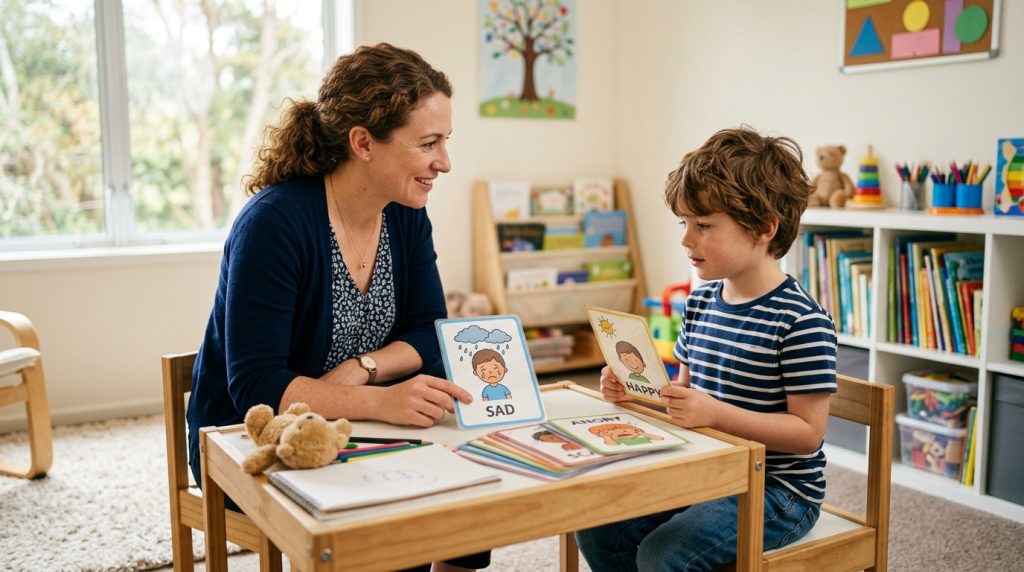
Build a larger vocabulary for feelings. Many children use only angry, sad, and fine. Introduce words such as frustrated, embarrassed, disappointed, worried, and left out. A simple rating scale from one to ten helps children who find it hard to describe feelings, because they can point to a number instead of searching for words.
Link feelings to the body. A racing heart, a tight stomach, hot cheeks, or clenched hands often appear before a child understands that they are upset. For autistic children, pictures, charts, and direct, literal language usually work better than hints. Ask what the body feels like, not only what the mind feels.
Adults can show the skill by using it. Saying aloud that you are annoyed and need a few minutes before you answer shows a child what the process looks like. Children with ADHD often need to see this many times, and in many settings, before they begin to use it themselves.
Protect the basics that affect mood. Regular sleep, meals, and physical activity all matter, and poor sleep in particular tends to make emotional reactions stronger. Predictable routines reduce the number of sudden changes a young person must cope with, which lowers the demand on their self-control.
Keep a simple mood record for a few weeks. Note the time of day, what happened, how strong the feeling was, and what helped. Patterns often appear, such as trouble after school or when medication wears off. Bring this record to the doctor, especially when a treatment is started or changed.
Do not stop or adjust ADHD medication without talking to the prescriber. If mood swings disrupt school, friendships, or family life, ask for an assessment, because treatment of ADHD, anxiety, or low mood may be needed alongside skills practice. Any talk of self-harm or suicide calls for prompt professional help.
Expect slow progress. Emotional skills develop over months and years, and they vary from day to day, especially under stress or fatigue. A child who handles a conflict well on Monday and struggles on Thursday is showing a normal uneven pattern, not a failure of the effort.
References
- Kotsou, I., Mikolajczak, M., Heeren, A., Grégoire, J., & Leys, C. (2019). Improving emotional intelligence: A systematic review of existing work and future challenges. Emotion Review, 11(2), 151–165.
- National Elf Service. (n.d.). Mood instability in autism and ADHD: More contacts with services. National Elf Service.
- Salovey, P., & Mayer, J. D. (1990). Emotional intelligence. Imagination, Cognition and Personality, 9(3), 185–211.
- Sánchez-Álvarez, N., Extremera, N., & Fernández-Berrocal, P. (2016). The relation between emotional intelligence and subjective well-being: A meta-analytic investigation. The Journal of Positive Psychology, 11(3), 276–285.
- Schutte, N. S., Malouff, J. M., Thorsteinsson, E. B., Bhullar, N., & Rooke, S. E. (2007). A meta-analytic investigation of the relationship between emotional intelligence and health. Personality and Individual Differences, 42(6), 921–933.
- Shaw, P., Stringaris, A., Nigg, J., & Leibenluft, E. (2014). Emotion dysregulation in attention deficit hyperactivity disorder. American Journal of Psychiatry, 171(3), 276–293.