
Mental resilience is the capacity to cope with stress, adapt to difficulty, and recover afterward. Many adults think of it as a trait of character that some people have and others lack. In clinical work, it turns out to be a set of skills and supports that develop over many years, and the earliest years matter a great deal.
Parents often ask what they can do now to protect a child from anxiety or depression later in life. No single action guarantees protection, and anyone who promises that is overstating the evidence. Still, some everyday habits are linked to better emotional and behavioral outcomes. Reading aloud with a young child is one of the simplest, cheapest, and best studied of these habits.
Why Mental Resilience Starts in Early Childhood
Ann Masten (2001) reviewed decades of research on children who did well despite hardship. She concluded that resilience usually comes from ordinary processes rather than rare qualities. A close relationship with a caring adult, the ability to learn and solve problems, and the ability to manage emotions and attention appeared again and again. Parents and teachers can influence all three.
Long-lasting adversity, such as neglect, family violence, or severe and chronic poverty, affects the developing brain and the body’s stress systems. Shonkoff, Garner, and colleagues (2012) used the term toxic stress for strong, frequent, or prolonged stress without enough adult support. Their review stressed that stable, responsive relationships reduce the harm. Reading together is one practical way to offer such a relationship every day.
Resilience in children rarely comes from one dramatic intervention. It develops through repeated, predictable moments of attention from an adult who responds to the child.
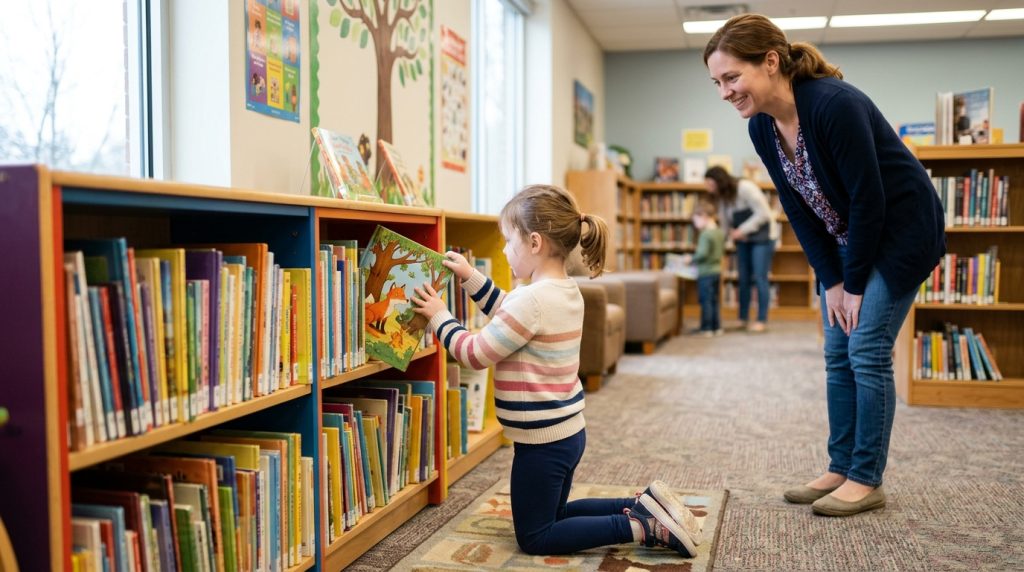
A picture book gives a parent and child a shared task that is calm and has a clear beginning and end. The child sits close, hears a familiar voice, and learns that questions and feelings are welcome. These moments are small, but they repeat hundreds of times before a child starts school.
What Reading Programs in Pediatric Care Have Shown
Some of the strongest evidence comes from programs run in pediatric clinics. In Reach Out and Read, doctors and nurses give books to families at routine checkups and advise parents on reading aloud. The American Academy of Pediatrics recommends that pediatric care include literacy promotion, with reading aloud encouraged from infancy (Council on Early Childhood et al., 2014).
High and colleagues (2000) studied literacy promotion in a primary care clinic and found that families who received books and advice read together more often. Their toddlers also scored higher on language tests. Mendelsohn and colleagues (2001) reported similar results in an inner-city clinic, where preschool children whose families took part in the program had better receptive and expressive language than comparison children.
Language is not the same as mental health, and this gap matters. Most early studies measured vocabulary and speech, not anxiety or mood. A later randomized trial helps close it. Mendelsohn and colleagues (2018) tested a program that coached parents in shared reading and play during early childhood. By preschool age, the children showed fewer behavior problems, including less hyperactivity and better attention.
These findings have limits. The effects were modest on average, and results for a group do not predict what will happen for one child. Families who accept a program may also differ from those who decline. The evidence supports reading together as a helpful habit that fits into a wider set of supports. It does not show that reading prevents mental illness.

Simple Ways to Read With Your Child at Home
Start early and keep it short. Ten to fifteen minutes a day is enough, and reading aloud can begin in the first months of life, long before a baby understands the words. A regular time, such as before bed or after a bath, helps the habit last. Missing a day is fine. What matters is the overall pattern across months and years.
Let the child lead. Young children often want the same book many times, and repetition helps them learn words and feel secure. Point to pictures, name what you see, and ask simple questions about what the characters are doing or feeling. If the child turns the page early or wanders off, follow that pace and return to the book later without pressure.
Books that describe feelings, such as fear, anger, or sadness, give children words for experiences they cannot yet explain. Afterward, you can ask what the character felt and whether the child has felt the same. Children who can name an emotion usually find it easier to tell an adult about it. That skill is useful at age four and at age fourteen.
Use the language you speak best at home. Reading in your first language is valuable even if the school uses another one, and the warmth in your voice carries over. Public libraries lend books for free and often hold story hours. Turn off the television and put phones away during reading time so the child has your full attention.
Some parents find reading hard because they struggle with literacy, or because they are exhausted or low in mood. You can tell a story from the pictures, or describe your day in simple words. If sadness, worry, or exhaustion lasts for weeks, speak with a doctor, because a parent’s own mental health strongly affects a child’s.
Reading together is a good habit, but it does not replace professional help. If a child has persistent anxiety, sleep problems, withdrawal, or sudden changes in behavior, a pediatrician or mental health professional should assess the child. Early evaluation is more reliable than waiting and hoping the problem passes, and daily shared reading can continue alongside any treatment.
References
- Council on Early Childhood, High, P. C., & Klass, P. (2014). Literacy promotion: An essential component of primary care pediatric practice. Pediatrics, 134(2), 404-409.
- High, P. C., LaGasse, L., Becker, S., Ahlgren, I., & Gardner, A. (2000). Literacy promotion in primary care pediatrics: Can we make a difference? Pediatrics, 105(Supplement 3), 927-934.
- Masten, A. S. (2001). Ordinary magic: Resilience processes in development. American Psychologist, 56(3), 227-238.
- Mendelsohn, A. L., Mogilner, L. N., Dreyer, B. P., et al. (2001). The impact of a clinic-based literacy intervention on language development in inner-city preschool children. Pediatrics, 107(1), 130-134.
- Mendelsohn, A. L., Cates, C. B., Weisleder, A., et al. (2018). Reading aloud, play, and social-emotional development. Pediatrics, 141(5), e20173393.
- Shonkoff, J. P., Garner, A. S., et al. (2012). The lifelong effects of early childhood adversity and toxic stress. Pediatrics, 129(1), e232-e246.