
Why school bullying affects mental health
School bullying means repeated harm from one or more children toward another child who has trouble defending themselves. It can be physical or verbal. It can also be social, such as exclusion and rumors, or it can happen online. It does so much damage because the child must return to the same place every day, often to the same people.
Parents often ask whether bullying is a normal part of growing up that children simply get over. The evidence does not support that view. In a systematic review and meta-analysis, Moore and colleagues (2017) found that children and adolescents who were bullied had a higher risk of depression, anxiety and suicidal thoughts than those who were not.
There is one caution. Most of these studies are observational, so they cannot prove that bullying alone caused the problems. Bullying may lead to anxiety, and anxiety may also make a child easier to target. Long follow-up studies help separate the two, because they record a child’s health before and after the bullying begins.
Copeland and colleagues (2013) followed about 1,400 children in North Carolina from childhood into adulthood. Children who had been bullied had more anxiety disorders as adults. Those who were both bullied and bullying others had the highest rates of depression, panic disorder and suicidal thinking. Children who only bullied others had a higher risk of antisocial personality disorder.
The same research group looked at health, money and relationships. Wolke and colleagues (2013) reported that bullied children were more likely, as adults, to have physical health problems, to struggle with steady work and savings, and to have fewer close relationships. These links largely remained after the researchers accounted for family hardship and earlier mental health problems.
This fits what clinicians who study the social determinants of health keep pointing out. Money, workload and connection with other people shape mental health in adults, and they do so in children as well. A child who is pushed out of a peer group loses a main source of connection, and that loss matters whether the child is eight or forty.

Signs that a child is being bullied
Children rarely report bullying. They may feel ashamed, fear that adults will make things worse, or believe they should handle it alone. So adults usually notice changes before they hear a story. Typical changes are stomachaches or headaches on school mornings, trouble falling asleep, a drop in grades, lost or damaged belongings and sudden reluctance to go to school.
One mother brought in her twelve-year-old son because of stomachaches that returned every Sunday evening. His doctor had found no physical cause. After several weeks of quiet conversation, he showed her a group chat in which classmates mocked him every day. His pain was real, and it eased once the school stepped in.
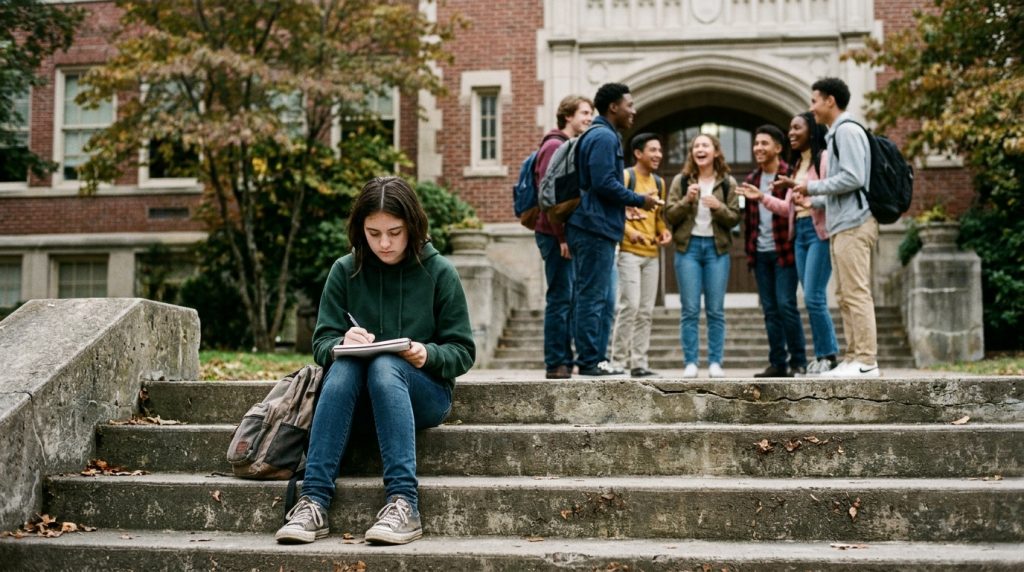
A child who is bullied rarely says so first, so a change in sleep, mood or school attendance may be the only sign adults get.
Online bullying deserves its own attention because it does not end when the school day does. A child who becomes secretive about a phone, or upset after looking at it, may be receiving messages that adults cannot see. Calm questions work better than demands to hand over the device, which can teach a child to hide more.
Irritability, anger at home and withdrawal from friends are also signs, especially in boys and teenagers, and they are easily mistaken for bad behavior. None of these signs proves that bullying is happening, since depression, family stress and other problems can look the same. They do justify a gentle conversation.
What helps at home and at school
The first step is to listen without reacting strongly. Let the child tell the story at their own pace, say clearly that the bullying is not their fault, and avoid advice such as hit back or ignore it. Both usually fail. Tell the child that you will act, and agree with them beforehand on what you will do.
Next, write down what happened, with dates, names and screenshots of messages. Then contact the school in writing and ask what it will do and when you will hear back. Most schools have a bullying policy, and a written request makes follow-up easier. If nothing changes, take the matter to the principal or the district office.
School-wide programs have evidence behind them. Gaffney and colleagues (2019) updated a meta-analysis of trials of school bullying prevention programs. They found that, on average, the programs reduced both bullying others and being bullied by roughly 15 to 20 percent. These are moderate gains, not a cure, and results differ from one school to another.
Support at home matters too. Keep the child’s friendships, sports and interests going, because they offer contact with people outside the group causing harm. One steady friend or a trusted adult at school can make the situation less isolating, although I know of no single step that protects every child.
Seek professional help when sadness, anxiety, sleep problems or school refusal last more than two weeks or interfere with daily life. Cognitive behavioral therapy, which teaches practical ways to handle anxious thoughts and social situations, is a well-tested treatment for depression and anxiety in adolescents.
If a child talks about self-harm or about not wanting to live, contact a doctor or an emergency service right away. In the United States, you can call or text 988. Stay with the child and take every such statement seriously, even if it is said in passing.
Children who bully also need attention. Many struggle to manage anger or have been mistreated themselves, and in the North Carolina study the children who were both bullied and bullying others had the greatest risk. Treating bullying as a problem of the whole peer group, and not only of the child who was targeted, gives the best chance of lasting change.
References
- Copeland, W. E., Wolke, D., Angold, A., & Costello, E. J. (2013). Adult psychiatric outcomes of bullying and being bullied by peers in childhood and adolescence. JAMA Psychiatry, 70(4), 419–426.
- Gaffney, H., Ttofi, M. M., & Farrington, D. P. (2019). Evaluating the effectiveness of school-bullying prevention programs: An updated meta-analytical review. Aggression and Violent Behavior, 45, 111–133.
- Moore, S. E., Norman, R. E., Suetani, S., Thomas, H. J., Sly, P. D., & Scott, J. G. (2017). Consequences of bullying victimization in childhood and adolescence: A systematic review and meta-analysis. World Journal of Psychiatry, 7(1), 60–76.
- Wolke, D., Copeland, W. E., Angold, A., & Costello, E. J. (2013). Impact of bullying in childhood on adult health, wealth, crime, and social outcomes. Psychological Science, 24(10), 1958–1970.