
Digital exhaustion is the tiredness that builds up after long hours of screen use, constant messages and back-to-back online meetings. It is not a medical diagnosis, and researchers define it in slightly different ways. Yet it is a common complaint. People describe a tiredness that sleep does not fully repair, even though they have spent most of the day sitting down.
What digital exhaustion looks like in daily life
A man in his forties once told me that he had done nothing all week except answer messages and attend meetings, and yet he came home every evening unable to read a page of a book. He felt lazy and ashamed. People with digital exhaustion often blame their character first, and many say nothing to anyone.
The signs are ordinary. There is mental fatigue by mid-afternoon, trouble concentrating, irritability with family, burning eyes, headaches, and an urge to check the phone when nothing is expected. Some people sleep badly. Others sleep enough and still wake unrefreshed. Because these signs overlap with depression, anxiety and burnout, a pattern that lasts for weeks deserves a proper assessment by a doctor.
Stigma plays a part. People with substance use problems often delay asking for help because they expect to be judged, and people worn out by technology do something similar. They assume everyone else copes, so they should too. Speaking about it openly, with a friend, a manager or a clinician, is a reasonable first step.
Why screens tire the mind and the body
Bailenson (2021) proposed four reasons why video calls in particular are tiring. They involve prolonged close-up eye contact, the extra effort of producing and reading nonverbal signals on a screen, constantly seeing your own face, and sitting still in front of a camera. This is a theoretical argument, not a proven model, but it gave researchers specific ideas to test.
Fauville and colleagues (2021) then developed a questionnaire, the Zoom Exhaustion and Fatigue Scale, which separates general, visual, social, emotional and motivational fatigue. The point is practical. Tiredness from screens is not one thing. A person may have sore eyes but a steady mood, or the reverse, and the best remedy depends on which part is affected.
Interruptions matter too. Ward and colleagues (2017) found that people performed worse on attention and memory tasks when their smartphone was on the desk than when it was in another room, even when it was silent. Later attempts to repeat this result have been mixed, so it should be treated as a possibility.
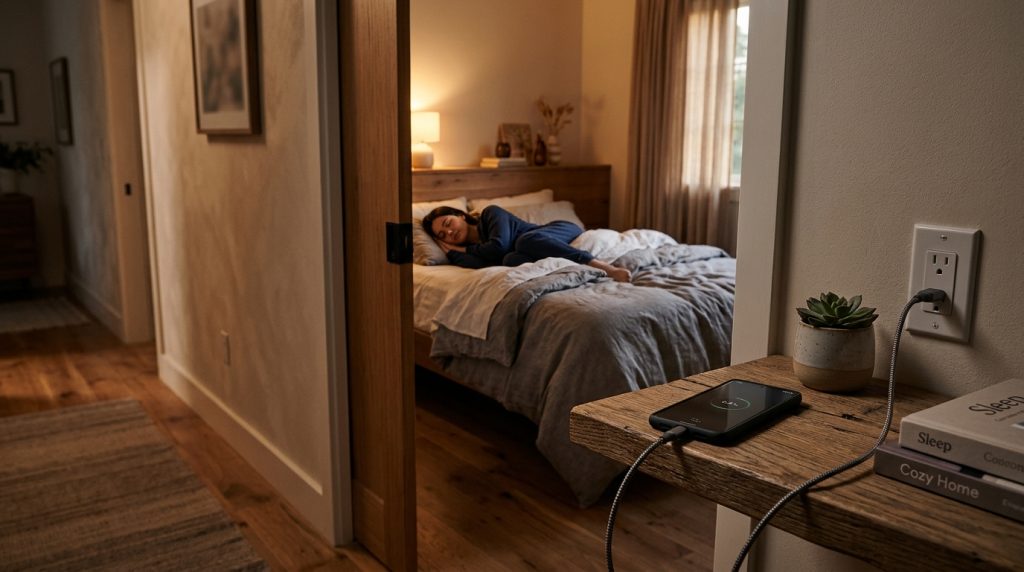
Sleep links screens to fatigue in a second way. Thomée and colleagues (2011) followed young Swedish adults for a year and found that heavy phone use predicted later sleep problems and symptoms of stress and depression, with different patterns in men and women. Exelmans and Van den Bulck (2016) found that bedtime phone use in adults went with poorer sleep and more tiredness.
These are observational findings, so they cannot show cause and effect. People who are already tired or low in mood may use their phones more, and the influence probably runs in both directions. What the findings do suggest is that screen habits and sleep are worth looking at together.
Practical steps that reduce screen tiredness
Hunt and colleagues (2018) tested the effect of limits directly. They asked 143 university students to restrict social media to ten minutes per platform per day for three weeks. Compared with a control group, the restricted students reported less loneliness and depression. The sample was small and young, so the result may not apply to everyone, but it supports setting limits.
Tiredness from screens is a real response to sustained demands on attention, and it can improve with practical changes in daily habits.
Start by noticing when the tiredness is worst. For one week, write down the times you feel most worn out and what you were doing before. Many people find that one or two activities stand out, such as long blocks of meetings or evening scrolling. That gives you something specific to change.
Reduce interruptions. Turn off notifications that are not urgent and check messages at set times, for example three times a day. Keep the phone out of sight during tasks that need concentration. On video calls, hide your own image if the software allows it, switch to audio only when the camera is not needed, and walk during calls that do not require a screen.

Build short breaks into the day. Leave ten minutes between meetings, and every twenty minutes or so look at something far away for about twenty seconds to rest your eyes. Eat lunch away from the screen. A short walk outside helps many people, and a face-to-face conversation may feel less tiring than a call.
Protect your sleep. Charge the phone outside the bedroom, use a simple alarm clock if you need one, and stop screens thirty to sixty minutes before bed. If you wake at night, avoid checking the phone. Better sleep will not remove digital exhaustion by itself, but poor sleep makes every other part of it worse.
Seek professional help if the tiredness lasts several weeks despite these changes, or if it comes with low mood, loss of interest, constant worry, hopelessness, or sleep problems that do not improve. A doctor can check for medical causes, and a mental health professional can assess for depression or anxiety. If you have thoughts of harming yourself, contact emergency services or a crisis line right away.
In the United States, you can call or text 988 at any time.
Research has not yet told us how much screen time is too much, and the limit probably differs from one person to another and from one kind of use to another. For now, the most useful measure is personal: how you feel after the screen is off, and whether you can still do the things that matter to you.
References
- Bailenson, J. N. (2021). Nonverbal overload: A theoretical argument for the causes of Zoom fatigue. Technology, Mind, and Behavior, 2(1).
- Exelmans, L., & Van den Bulck, J. (2016). Bedtime mobile phone use and sleep in adults. Social Science & Medicine, 148, 93-101.
- Fauville, G., Luo, M., Muller Queiroz, A. C., Bailenson, J. N., & Hancock, J. (2021). Zoom Exhaustion & Fatigue Scale. Computers in Human Behavior Reports, 4, 100119.
- Hunt, M. G., Marx, R., Lipson, C., & Young, J. (2018). No more FOMO: Limiting social media decreases loneliness and depression. Journal of Social and Clinical Psychology, 37(10), 751-768.
- Thomée, S., Härenstam, A., & Hagberg, M. (2011). Mobile phone use and stress, sleep disturbances, and symptoms of depression among young adults: A prospective cohort study. BMC Public Health, 11, 66.
- Ward, A. F., Duke, K., Gneezy, A., & Bos, M. W. (2017). Brain drain: The mere presence of one’s own smartphone reduces available cognitive capacity. Journal of the Association for Consumer Research, 2(2), 140-154.