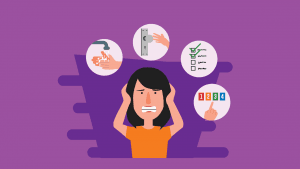
Phobias are intense, lasting fears of a specific object or situation that is not truly dangerous, or is far less dangerous than the fear suggests. Common examples are flying, heights, dogs, spiders, injections, enclosed spaces and the sight of blood. The fear appears almost every time the person meets the object, and the person avoids it or endures it with great distress.
Doctors diagnose a specific phobia when the fear is out of proportion to the real risk, lasts six months or longer, and interferes with daily life. That interference can be obvious, such as a person who cannot take a job that requires air travel. It can also be quiet, such as someone who skips dental care for years because of a fear of needles.
Phobias are among the most common anxiety problems. In the large US National Comorbidity Survey Replication, Kessler and colleagues (2005) found that about 12 percent of adults had met criteria for a specific phobia at some point in life. A later analysis of surveys from many countries, by Wardenaar and colleagues (2017), found a lower figure of roughly 7 percent, with women affected about twice as often as men. Differences in survey methods probably explain part of the gap.
Why Phobias Develop and Why They Last
Most phobias begin in childhood or adolescence. Some start after a frightening event, such as a dog bite or a panic attack on a plane. Others start after watching a parent react with fear, or after hearing repeated warnings. Many people cannot name any cause at all, and that does not make the fear less real or harder to treat.
Genes play a role too. In their review of specific phobias, Eaton and colleagues (2018) describe moderate family clustering, which suggests that some people are born more sensitive to fear. A family history does not mean a phobia is certain. It means the person may need less of a frightening experience for a fear to take hold.
What keeps a phobia going is mostly avoidance. Each time a person steps away from the feared object, the anxiety drops quickly, and the brain registers that leaving was the right decision. The person never learns that the fear would have faded on its own, or that the feared outcome was unlikely. Over months and years, the list of avoided situations often grows.
There is no blood test or scan for phobias. Researchers are developing blood tests that may predict conditions such as Alzheimer’s disease years ahead, but a phobia is identified through conversation. A clinician asks what situations cause fear, how the person reacts, what they avoid, how long this has lasted and what it costs them in daily life.

How Phobias Are Treated
The best-supported treatment is exposure therapy, a form of cognitive behavioral therapy. The person meets the feared object or situation in small, planned steps, and stays long enough to notice that the fear rises, peaks and then falls without the feared outcome happening. Repeating this teaches the brain a new association that avoidance never allows.
Wolitzky-Taylor and colleagues (2008) pooled the results of many trials of psychological treatments for specific phobias. They found that exposure-based treatment worked clearly better than no treatment or placebo conditions, and that exposure in real life usually did better than exposure only in imagination. Most trials were short, and the benefits generally held at follow-up.

Treatment usually starts by building a fear hierarchy, which is a list of situations ranked from mildly to severely frightening. For a fear of dogs, the first step might be looking at photographs, and a later step might be standing across the street from a calm dog on a leash. The therapist and patient move up the list at a pace the patient agrees to.
Many people improve within a limited number of sessions, and some respond to a single long session. Medication is not the usual first choice for specific phobias. Sedatives such as benzodiazepines may reduce the learning that happens during exposure, and they can lead to dependence, so they are best reserved for rare, carefully considered situations.
Fear of blood, injections and injury is different from other phobias. The body can respond with a sudden drop in heart rate and blood pressure, and the person may faint. For this reason, therapists often add a technique called applied tension, in which the person tenses large muscles for short periods to raise blood pressure during exposure.
What You Can Do on Your Own
If your fear is mild and limited, you can begin with gradual exposure yourself. Write down the situations you avoid and rank them by difficulty. Start with one that makes you only a little anxious, stay in it until the anxiety clearly drops, and repeat it on several days before moving up. Short, frequent practice works better than rare, intense attempts.
Avoidance brings relief at once, but it keeps the fear in place. Facing the feared thing in small steps, and staying until the anxiety drops, is what weakens a phobia.
Watch for small habits that work as avoidance in disguise, such as keeping your eyes closed, holding a companion’s hand, checking exits, or having a drink before a flight. These can lower anxiety for a moment while teaching you that you only managed because of the habit. Try to drop them gradually as your confidence grows.
Some people find that slow breathing helps them stay in the situation. That is fine, as long as it is used to stay and not to escape. Avoid using alcohol to get through exposure, because it can make anxiety worse the next day and prevents you from seeing that you can cope without it.
Consider professional help if the fear limits your work, relationships, travel or health care, if you have panic attacks, or if self-directed practice has stalled. A phobia of medical procedures deserves particular attention, since it can lead people to delay care they need. Tell your doctor about the fear, and ask for a referral to a therapist trained in exposure.
With children, avoid forcing them into the feared situation or dismissing the fear. Acknowledge it, and help them take small steps with praise for each attempt. Parents can also notice their own reactions, since children copy how adults respond to dogs, storms or doctors. If a child’s fear affects school or sleep, ask a pediatrician or child therapist for an assessment.
Not every phobia needs treatment. A person who fears snakes and lives in a city may reasonably decide to leave it alone. The question is whether the fear shrinks the life you want to live. If it does, the evidence is encouraging, because the treatment is short, practical and effective for most people who complete it.
References
- Eaton, W. W., Bienvenu, O. J., & Miloyan, B. (2018). Specific phobias. The Lancet Psychiatry, 5(8), 678-686.
- Kessler, R. C., Berglund, P., Demler, O., Jin, R., Merikangas, K. R., & Walters, E. E. (2005). Lifetime prevalence and age-of-onset distributions of DSM-IV disorders in the National Comorbidity Survey Replication. Archives of General Psychiatry, 62(6), 593-602.
- Wardenaar, K. J., Lim, C. C. W., Al-Hamzawi, A. O., et al. (2017). The cross-national epidemiology of specific phobia in the World Mental Health Surveys. Psychological Medicine, 47(10), 1744-1760.
- Wolitzky-Taylor, K. B., Horowitz, J. D., Powers, M. B., & Telch, M. J. (2008). Psychological approaches in the treatment of specific phobias: A meta-analysis. Clinical Psychology Review, 28(6), 1021-1037.